
Hades and Thanatos are two distinct figures in Greek mythology often confused due to their associations with death. Hades is the god of the Underworld, while Thanatos is the personification of death itself. This article explores their differences, roles, and relationships within the mythological framework [1].
Understanding Hades: The God of the Underworld
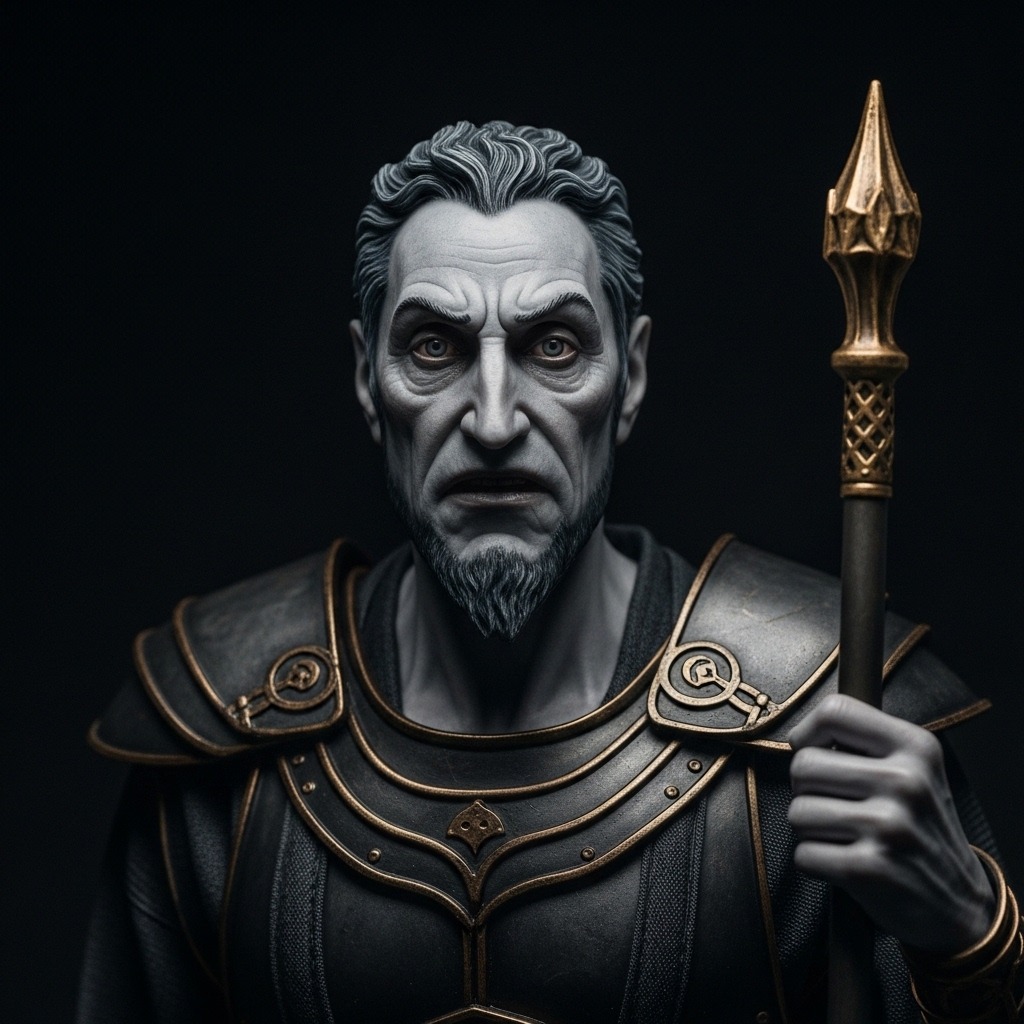
Hades holds a paramount position in Greek mythology as the ruler of the Underworld. His responsibilities extend far beyond merely presiding over the dead; he is integral to the cosmic order and the afterlife.
Hades’ Origins and Family
Hades is the eldest son of Cronus and Rhea, brother to Zeus and Poseidon. After the Titanomachy, the three brothers divided the cosmos. Hades drew the short straw, receiving dominion over the Underworld. This allocation underscores his significance, as he oversees the realm of the dead, ensuring it operates under strict order. His family connections also include Persephone, his wife, who plays a crucial role in his narrative and highlights his dual nature as both a ruler and a husband.
Key Myths Involving Hades
Several myths illustrate Hades’ multifaceted character:
- The Abduction of Persephone: This pivotal myth not only showcases his role as a husband but also reveals the cycle of seasons, linking Hades to nature’s rhythms.
- The Twelve Labors of Heracles: In this myth, Heracles must retrieve Cerberus, Hades’ three-headed guardian, emphasizing Hades’ authority over the creatures of the Underworld.
- The Judgment of Souls: Hades governs the arrival of souls through a triad of judges—Minos, Rhadamanthus, and Aeacus—who determine their fates in the afterlife, reinforcing his role as the keeper of souls [2].
Hades’ Symbolism in Greek Culture
Hades embodies a complex relationship with death. Unlike Thanatos, who represents a more peaceful transition, Hades governs the entirety of the Underworld, ensuring that souls receive their just fates. His image evokes both fear and respect. The Helm of Darkness, a symbol of his power, signifies his ability to maintain order and invisibility, portraying him as a formidable figure rather than an evil one.
In art and literature, Hades is often depicted sternly, reflecting his serious demeanor. His role as the “unseen one” draws a line between him and Thanatos, who personifies a gentler form of death. This distinction is crucial for understanding their differences in the mythological context.
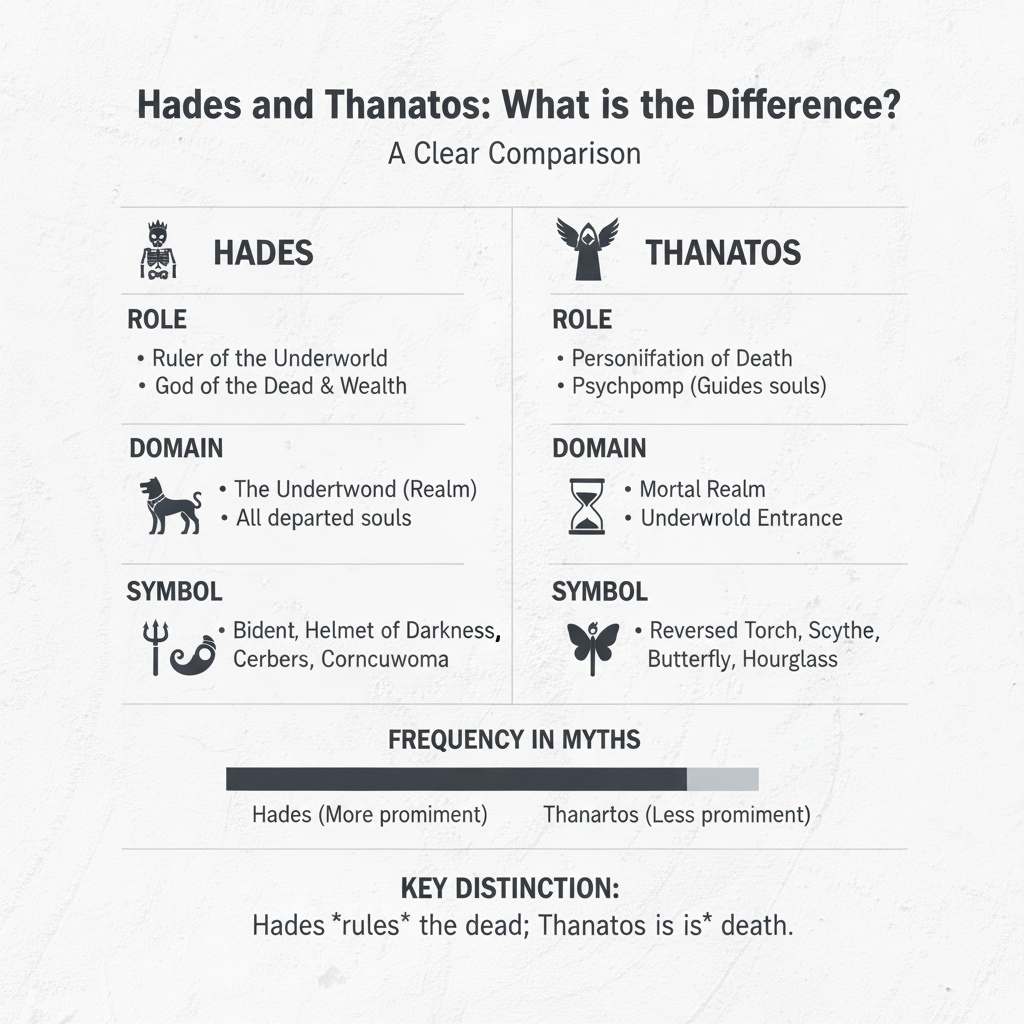
| Aspect | Hades | Thanatos |
|---|---|---|
| Role | Ruler of the Underworld | Personification of nonviolent death |
| Responsibilities | Governing souls, overseeing the dead | Guiding souls to the afterlife |
| Symbolism | Authority, order, fear | Peaceful, gentle transition |
This table highlights their contrasting roles, further clarifying the distinction between Hades and Thanatos in the cultural imagination.
Table of Contents
Exploring Thanatos: The Personification of Death

Thanatos embodies death itself in Greek mythology. As a primordial entity, he plays a crucial role as a psychopomp, guiding souls to the Underworld. Understanding his origin, family ties, and functions reveals the nuanced differences between him and Hades.
Thanatos’ Family and Genealogy
Thanatos is the offspring of Nyx, the goddess of night, and Erebus, the personification of darkness. This lineage places him in a family of deities who personify abstract concepts. His siblings include Hypnos, the god of sleep, and the Keres, spirits of violent death. This connection emphasizes Thanatos’s role as a peaceful guide in contrast to the more chaotic aspects of death represented by the Keres. While Hades governs the Underworld, Thanatos is intrinsically tied to the act of dying itself, working under Hades’ command.
Depictions of Thanatos in Art and Literature
Thanatos is often depicted as a youthful figure with wings, symbolizing his role in escorting souls. Ancient texts, such as those by Hesiod, describe him as a cold yet necessary force in the cycle of life and death. In Greek tragedies, Thanatos appears in various forms, sometimes as a merciless figure and other times as a compassionate guide. For example, in the myth of Heracles, he is confronted by the hero, illustrating the tension between life and death. This duality showcases Thanatos as both an inescapable force and a gentle spirit guiding souls peacefully to the afterlife [5].
How Thanatos Functions in Myths
Thanatos serves a pivotal function in ancient myths. He is often portrayed as the one who collects souls when their time is up, ensuring the natural order is maintained. His presence reinforces the inevitability of death, a theme deeply woven into Greek mythology. For instance, in certain myths, when Thanatos is captured, no mortal can die, leading to chaos among the living [6]. This illustrates the essential balance that Thanatos maintains alongside Hades, who rules the realm where these souls reside.
- Key Roles of Thanatos:
- Psychopomp: Guides souls to the Underworld.
- Personification of Death: Represents the peaceful aspect of dying.
- Family Ties: Connected to Nyx and Erebus; brother to Hypnos.
- Artistic Representation: Often depicted as a winged youth.
Understanding Thanatos enriches the narrative of Greek mythology, highlighting his crucial role in the cycle of life and death, distinctly separate from Hades’ governance of the Underworld.
Key Differences Between Hades and Thanatos

Hades and Thanatos, two prominent figures in Greek mythology, embody different aspects of death and the afterlife. Understanding their distinct roles clarifies common misconceptions.
Role Comparison: Ruler vs. Personification
Hades is the god of the Underworld, governing the realm of the dead. He is one of the three brothers, alongside Zeus and Poseidon, who divided the cosmos after defeating the Titans. In contrast, Thanatos is the personification of death itself. He encapsulates the concept of dying, representing the inevitable end of life.
| Feature | Hades | Thanatos |
|---|---|---|
| Domain | Rules the Underworld | Personification of death |
| Role | Governs the dead and their afterlife | Represents the act of dying |
| Family Connections | Brother of Zeus and Poseidon | Son of Nyx, brother of Hypnos |
| Cultural Depiction | Often portrayed as stern and unyielding | Often depicted as a gentle figure |
Powers and Responsibilities
Hades wields significant power over the dead. He controls the Underworld’s gates, ensuring that souls enter and do not escape. His responsibilities include maintaining order among the deceased and overseeing their final destinations. Conversely, Thanatos’ role is more passive. He is not a judge or keeper of souls; rather, he facilitates the transition from life to death. His presence signifies the end of life, often depicted as a gentle guide rather than a force of terror.
Cultural Perceptions of Death
In ancient Greece, death was viewed through various lenses, from fear to reverence. Hades, as a ruler, often elicited fear due to his dominion over the Underworld. His portrayal in art and literature reflects this perception—he is typically shown with a stern demeanor, symbolizing the finality of death. Thanatos, however, is often seen as a peaceful figure, embodying a natural part of life. This duality highlights how different aspects of death were understood in ancient culture.
Common Misconceptions
Many confuse Hades and Thanatos, assuming they are interchangeable. However, Hades governs the realm of the dead, while Thanatos merely personifies death. Another misconception is that Hades is evil or malevolent—he is simply a necessary force in the cycle of life and death. Understanding these distinctions is crucial for grasping their roles within Greek mythology.
The Interplay Between Hades and Thanatos in Mythology

In Greek mythology, Hades and Thanatos often collaborate in the domain of the afterlife. Their interactions reveal the nuanced relationship between the ruler of the Underworld and the personification of death.
Myths Featuring Hades and Thanatos
Several myths illustrate the dynamic between Hades and Thanatos. One of the most notable stories involves Sisyphus. Sisyphus attempted to cheat death by capturing Thanatos. In response, Hades intervened, ensuring that Sisyphus faced punishment in the Underworld, where he was condemned to roll a boulder up a hill for eternity. This myth emphasizes Hades’s authoritative role in the afterlife while showcasing Thanatos’s function as the harbinger of death [5].
Another significant myth is the tale of Orpheus. After Eurydice’s death, Orpheus journeyed to the Underworld to reclaim her. Hades agreed to let Eurydice return to the living, but only if Orpheus did not look back at her. In this myth, Thanatos’s role is more subdued, but Hades’s power and authority are central as he governs the conditions of life and death [9].
The Dynamics of Their Relationship
The relationship between Hades and Thanatos is complex. Hades rules over the Underworld, while Thanatos embodies the concept of death itself. Hades is an Olympian god, with powers to decide the fate of souls, whereas Thanatos serves as a subordinate figure, facilitating the transition from life to death.
- Hades: King of the Underworld, governs the souls of the deceased.
- Thanatos: Personifies death, responsible for escorting souls to Hades.
This distinction highlights their respective roles. Hades oversees the realm where souls reside, while Thanatos functions as the necessary force that brings souls to Hades [5].
Their Collective Role in Greek Mythology
Together, Hades and Thanatos illustrate the Greek understanding of death and the afterlife. Hades embodies the finality and governance of death, lending authority to the process of dying, while Thanatos represents the inevitability of death itself. Their roles reflect cultural perceptions of death—one as a ruler and the other as a gentle guide.
In ancient art and literature, their depictions further emphasize these roles. Hades is often shown with a stern demeanor, symbolizing his authority. In contrast, Thanatos is frequently represented as a more serene figure, emphasizing the peaceful nature of death [9].
Understanding their interplay enhances our comprehension of Greek mythology’s intricate views on life, death, and the afterlife.
Conclusion: Understanding Death in Greek Mythology
In Greek mythology, Hades and Thanatos serve distinct yet interconnected roles regarding death and the afterlife. While Hades governs the Underworld, Thanatos embodies the concept of death itself.
Distinct Roles in Mythology
- Hades: The god of the Underworld, Hades oversees the realm of the dead and ensures the order of mortality. He is often depicted as a stern figure, reflecting his authority over life and death [9].
- Thanatos: As the personification of death, Thanatos represents the gentle release from life. His character is often shown as a serene presence, contrasting Hades’ sternness. He carries souls to the afterlife, serving as a guide rather than a ruler [8].
Genealogy and Relationships
- Family Connections: Thanatos is a son of Nyx, the goddess of night, and is related to other significant figures like Hypnos (sleep) and Ares (war) [1]. This lineage underscores the complexity of death’s portrayal in mythology, linking it to broader themes of sleep and conflict.
- Interplay Between Hades and Thanatos: Their interactions highlight the relationship between authority and inevitability. For example, in the myth of Sisyphus, Thanatos is captured by the king, leading to chaos in the natural order until Hades intervenes [6].
Cultural Perceptions of Death
The Greek understanding of death is multifaceted. Hades symbolizes the unchangeable nature of death, while Thanatos reflects society’s perception of dying as a peaceful transition. Art and literature portray these figures, reinforcing their respective roles. For instance, Hades is often illustrated with symbols of power, such as the bident, whereas Thanatos is depicted with wings, emphasizing his role as a gentle guide [9].
Key Takeaways
- Authority vs. Personification: Hades rules over the dead, while Thanatos personifies death itself.
- Cultural Symbolism: Hades represents the finality of death; Thanatos signifies its inevitability and peacefulness.
- Mythical Interactions: Their stories illustrate the balance of power and the cycle of life and death within Greek mythology.
Understanding these differences enhances our appreciation of how ancient Greeks viewed mortality and the afterlife, reflecting their beliefs and cultural values.
Frequently Asked Questions
These quick answers cover the most common questions about this topic, including key details, practical tips, and common concerns.
Hades and Thanatos: What is the Difference?
Hades is the Greek god who rules the Underworld and oversees the realm of the dead. Thanatos is the personification of death itself, representing the act of dying. Hades governs the final resting place of souls, while Thanatos symbolizes the process and peaceful transition of death [1][2].
Are Thanatos and Hades the same god?
No, they are not the same. Hades is an Olympian god and ruler of the Underworld, responsible for maintaining order among the dead. Thanatos is a primordial deity representing death, acting as a gentle guide for souls rather than a ruler [1][5].
Who are the big 3 of gods?
The “big 3” Greek gods are Zeus, Poseidon, and Hades. They are brothers who divided the cosmos after defeating the Titans. Zeus rules the sky, Poseidon the sea, and Hades the Underworld [3].
Which Greek god hates Hades?
There is no specific myth indicating a Greek god who hates Hades. However, some myths depict conflicts involving gods like Ares or others who oppose or challenge Hades, but these are not characterized by hatred. Generally, Hades maintains a neutral or respected position among gods [7].
Why did Jesus say Hades?
In the New Testament, “Hades” is used as a term for the realm of the dead, similar to the Greek concept. Jesus used “Hades” to refer to the place of the departed spirits, aligning with the cultural understanding of the underworld as a temporary realm for souls awaiting judgment [4].
What are the main differences between Hades and Thanatos?
Hades is the ruler of the Underworld, responsible for governing the dead and maintaining order in the afterlife. Thanatos is the personification of death, embodying the peaceful act of dying and escorting souls to Hades. Hades has authority, while Thanatos is a guiding force [1][5].
How do Hades and Thanatos relate to each other?
They interact in myths where Thanatos acts as the agent of death, and Hades as the ruler of the realm where souls go. Sometimes, Thanatos is depicted as working under Hades or in tandem with him, especially in myths like the capture of Thanatos by Sisyphus. Their relationship emphasizes the distinction between death as an act and the domain of the dead [5][6].
What roles do Hades and Thanatos play in Greek mythology?
Hades governs the Underworld, overseeing the fate of souls and maintaining cosmic order. Thanatos embodies the gentle, inevitable process of death, guiding souls peacefully to the afterlife. Their roles highlight different aspects of mortality—authority and transition [1][2][8].
Who are the parents of Hades and Thanatos?
Hades is the son of Cronus and Rhea, making him a Olympian deity. Thanatos is the son of Nyx (Night) and Erebus (Darkness), placing him among primordial deities associated with abstract concepts like night and death [1][8].
What is the significance of Thanatos in Greek culture?
Thanatos represents the natural and peaceful aspect of death, contrasting with more violent or chaotic forms. His presence underscores the acceptance of death as part of life’s cycle. In art and literature, Thanatos symbolizes the gentle transition from life to afterlife, reflecting cultural attitudes towards mortality [5][8].
References
1. Underworld: Imagining the Afterlife – Getty Museum
2. I am Hades: King of the Underworld, Lord and Collector …
4. To and Fro Between Eros and Thanatos – PMC – NIH
5. Exploring the Role of Thanatos in Ancient Greek Art and …
7. Hades | The God Of High School Wiki | Fandom
8. Treatise of Thanatology – PMC – NIH
9. Thanatos – Hades Wiki – Fandom