
The piano is both a string and a percussion instrument because its hammers strike strings to produce sound, yet it is played by striking keys, functioning as a struck instrument.
This article will explain the dual nature of the piano, exploring how it fits into both instrument families and what that means for performers and audiences alike.
How the Piano Produces Sound: String Vibration and Hammer Action
The sound of a piano results from a combination of string vibrations and the hammer’s strike, which together create its distinctive tonal qualities. Understanding these sound production mechanisms sheds light on why the piano is classified as both a string and a percussion instrument.
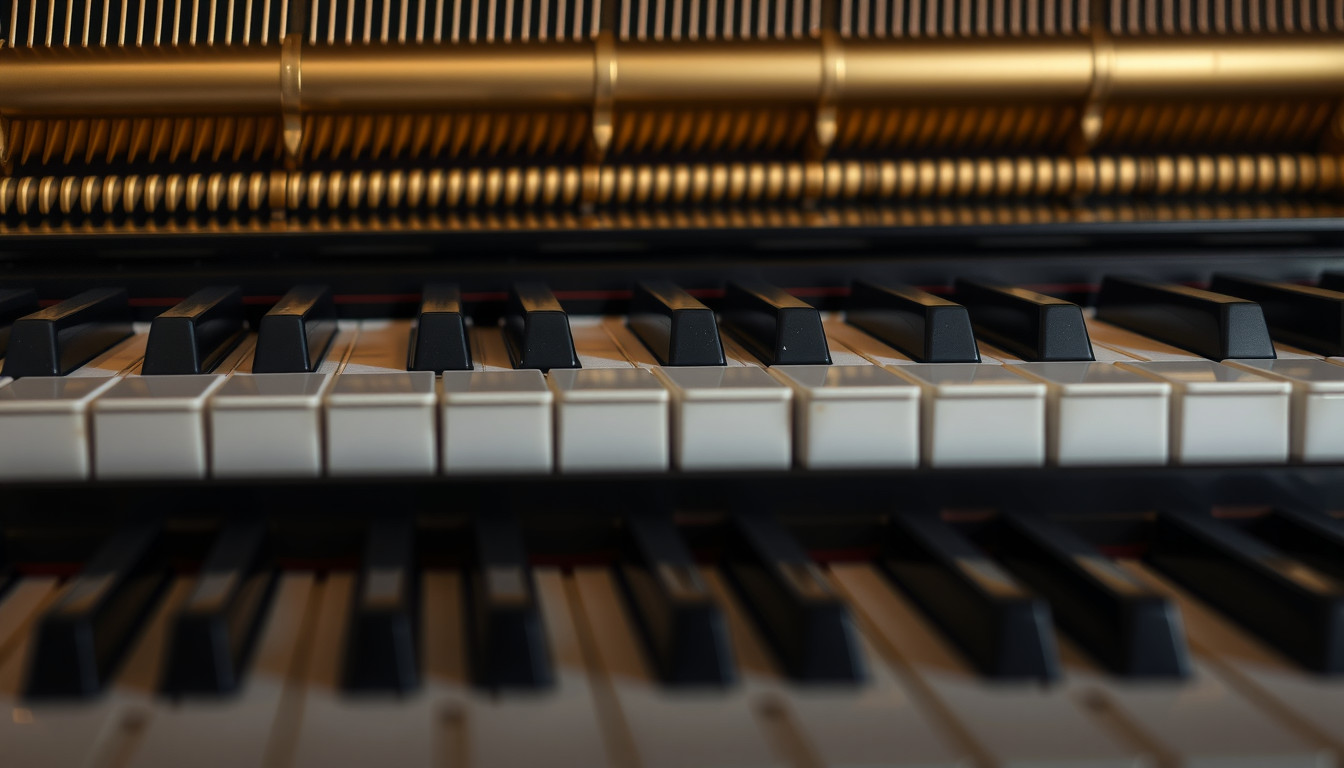
1. The role of strings in sound creation
Piano strings are carefully tuned to specific pitches. When a key is pressed, a felt hammer strikes one or more of these strings. The tension and length of each string determine the pitch it produces, with longer, looser strings vibrating at lower frequencies and shorter, tighter strings at higher pitches.
During a typical play, the vibration is initiated by the hammer strike and then continues as the string oscillates. These vibrations spread along the length of the string, creating a rhythmic and tonal vibration pattern that influences the sound’s clarity and brightness.
Each string is anchored at both ends by tuning pins, which maintain correct tension. Multiple strings can be associated with a single note—especially in the mid-range of a piano—to reinforce the sound and produce a richer tone. The vibration of these strings is the primary source of the piano’s tone and pitch accuracy.
2. How felt hammers induce vibrations
When a pianist presses a key, a mechanism inside the piano causes a felt-covered hammer to propel upward and strike the corresponding string(s). The choice of felt as the striking material provides a soft, controlled impact that influences the timbre. The strike itself is precise and force-dependent, affecting the volume and attack of the sound.
Once the hammer hits the string, it immediately drops away, leaving the string free to vibrate. The force of the hammer’s strike determines the initial amplitude of vibrations—harder strikes produce louder sounds, softer strikes generate quieter notes.
These vibrations spread to the soundboard—a large, wooden surface beneath the strings. The soundboard amplifies the vibrations, transforming them into a fuller, more resonant tone. The decay and sustain of the note depend on how quickly the vibrations dissipate, which is controlled by damping mechanisms such as felt dampers that stop the string vibrations when the key is released.
| Component | Function |
|---|---|
| Strings | Vibrate when struck, producing specific pitches based on their length, tension, and mass. |
| Hammer | Strikes the strings with controlled force when a key is pressed, initiating vibrations. |
| Soundboard | Amplifies the vibrations from the strings, creating the characteristic piano sound. |
Classifying the Piano as Both a String and Percussion Instrument
The piano’s classification hinges on its unique sound production and playing mechanism, which embody characteristics of both string and percussion instruments. In music theory, the formal classification considers how sound is generated and how the instrument is played, leading to the piano being categorized as a “struck-string” instrument. This dual classification reflects the complex nature of its sound creation process and playing technique, making it a versatile instrument in various musical contexts.
1. Official classification in music theory
According to authoritative sources like piano.org and pianoarea.com, the piano is classified as a chordophone—specifically, a struck-string instrument. When a pianist presses a key, a felt hammer is propelled upward to hit a set of tuned strings, causing them to vibrate and produce sound. These vibrations are then amplified by the soundboard, creating the musical tone we hear. This mechanism aligns with the broader family of string instruments such as violins, guitars, and harps, where the fundamental sound production involves vibrating strings.
2. Why it's considered both
The dual nature of the piano emerges from the fact that while its sound originates from vibrating strings, the act of sound production involves striking. Unlike bowed or plucked string instruments, the pianist does not manipulate the strings directly but instead uses hammers to strike them. This striking action is a defining characteristic of percussion instruments. The sound decay—how the tone gradually diminishes—further supports its classification as a percussion instrument. Once struck, the strings’ vibrations diminish naturally, akin to a percussion instrument like a drum or cymbal where the sound fades over time. Recognizing these traits, most classifications describe the piano as a “struck-string” instrument that also embodies percussion qualities in its playing technique.
The Mechanics of Piano Play: Keys, Hammers, and Sound Decay
When a pianist presses a key on the piano, a complex series of mechanical actions occurs that produces sound. Unlike string instruments, where sound is generated primarily by vibrating strings, the piano’s sound results from a percussive attack followed by a natural decay. The process begins with the play action: pressing a key triggers a felt-covered hammer to strike one or multiple strings tuned to specific pitches. This action creates a rapid, forceful impact that defines the piano’s percussive nature. The subsequent sound behavior depends on how the vibrations of these strings evolve after being struck, which in turn influences the instrument’s classification as a percussion or string instrument.
1. How pressing keys activates hammers
Pressing a key causes a mechanical linkage to move a felt hammer upward, momentarily striking the corresponding string or set of strings. This impact delivers a sharp, immediate attack characteristic of percussion instruments. The hammer strikes with enough force to set the string into vibration, generating a note. The intensity of the key press affects the strength of the hammer strike, contributing to the dynamic range of the instrument. Because this strike is discrete and abrupt, the initial note onset aligns with the defining feature of percussion sounds.
2. Sound decay and sustain limitations
After the initial impact, the string continues to vibrate, producing sound that naturally diminishes over time. Unlike a bowed instrument, where continuous bowing can sustain a note, the piano relies solely on the initial strike. The vibrations gradually fade as energy dissipates through air, the soundboard, and internal damping mechanisms. This decay process typically occurs within a few seconds, giving the piano its characteristic short, percussive sound rather than the sustained tones of a violin or cello. The instrument’s design intentionally limits sustained resonance, reinforcing its classification as a strike-based, percussion-like instrument rather than a sustained string instrument.
3. Implications for classification
The combination of these mechanical and acoustic behaviors influences how the piano is categorized. The key press triggers a percussive impact, and the note’s decay resembles that of percussion instruments like drums or mallet instruments. The absence of continuous vibrato or sustained modulation, typical of many stringed instruments, further supports this classification. While the vibrating strings are the source of the sound, the manner of sound production—initial strike and subsequent decay—aligns more closely with percussion instruments than with bowed or plucked string instruments. As a result, the piano is best described as a struck-string keyboard instrument with significant percussion qualities.
Additional Classifications and Variations of the Piano
The broad spectrum of pianos includes several types, each distinguished by construction, sound production method, and historical classification. These variations reflect technological advances, artistic preferences, and functional requirements, making the piano a complex and diverse instrument family.
1. Historical classification systems
Early piano classifications focused heavily on construction methods, such as the materials used for soundboards and frames, as well as the mechanisms of action. Historically, pianos were categorized into early types like the fortepiano, which used wooden frames and smaller strings, and the classic grand piano, featuring steel frames and longer strings for richer sound. These systems often emphasized structural features and aimed to highlight technological progress over time.
2. Types of pianos (grand, upright, digital)
Modern classifications distinguish pianos primarily based on shape, size, and sound reproduction technology. Grand pianos, characterized by their large horizontal structure and lengthy strings, produce a broad tonal range and dynamic expression. Upright pianos are more compact, with vertical strings and a smaller footprint, making them suitable for limited spaces but still capable of expressive playing. Digital pianos replicate the sounds of acoustic instruments using electronic sampling; they lack the physical strings and vibration mechanisms of traditional pianos but offer versatility and additional features for learners and performers alike.
3. Unique sound production methods
Beyond traditional acoustic strings, some pianos incorporate innovative sound production techniques. For example, hybrid pianos combine acoustic and digital elements, utilizing physical strings alongside digital sound synthesis. Certain specialized pianos focus on specific sound qualities, such as silent pianos that allow playing through headphones by disabling the acoustic sound—emphasizing functionality over traditional sound propagation. Others may utilize percussive mechanisms that mimic percussion instruments, with sound generated through striking physical components rather than vibrating strings, resulting in distinct auditory and tactile experiences.
| Instrument Family | Primary Sound Production Method | Examples |
|---|---|---|
| Acoustic Pianos | String vibration initiated by hammer strikes | Grand, upright, spinet, console |
| Digital Pianos | Electronic sampling and synthesis of acoustic sounds | Stage pianos, portable keyboards |
| Hybrid Pianos | Combination of acoustic strings and digital sound | Hybrid grand, digital-analog interfaces |
| Percussion-Inspired Variations | Mechanical striking components simulating percussion | Percussive digital pianos, some avant-garde designs |
These classifications show the range of technical and aesthetic choices within the piano family, illustrating that what defines a piano extends beyond simple structural features. The evolution continues as new sound production methods and hybrid designs emerge, blending traditional attributes with modern innovations.
Frequently Asked Questions
1. Is the piano more of a string or percussion instrument?
The piano is classified as a struck-string instrument with percussion qualities because it produces sound by striking strings and has a percussive attack.
2. How does the sound decay influence its classification?
The natural fading of vibration after a string is struck aligns with percussion instrument characteristics, supporting its dual classification.
3. Can a piano be played like a string instrument?
While it uses strings, a piano is played by pressing keys that activate hammers, not by bowing or plucking like traditional string instruments.
4. Why do musicians sometimes call the piano a percussion instrument?
Its sound is initiated by hammers striking strings, creating a percussive attack similar to drums and cymbals.
5. Are all pianos classified the same way?
Yes, all pianos are generally considered struck-string instruments with percussion qualities, regardless of type or size.
6. How do digital pianos differ in classifying methods?
Digital pianos do not produce sound via strings but simulate the hammer striking process, so they are classified mainly by sound synthesis rather than physical sound production.
7. What practical effects does this classification have for performers?
Classifying pianos as percussion influences how performers approach dynamics and attack, and guides instrument choice for specific musical contexts.